The Philippines Has a Legal Data Problem. Anycase.ai is Fixing It, One Source at a Time
Gio Tiongson

I wasn’t sure what to expect walking into OpenAI Founder Day in Singapore.
Five startups from across Southeast Asia were invited to share what they were building. We were the only ones from the Philippines. And when you're standing in a room full of serious AI companies, you start to wonder whether the thing you've been grinding on for the past few years is actually as important as you think it is.
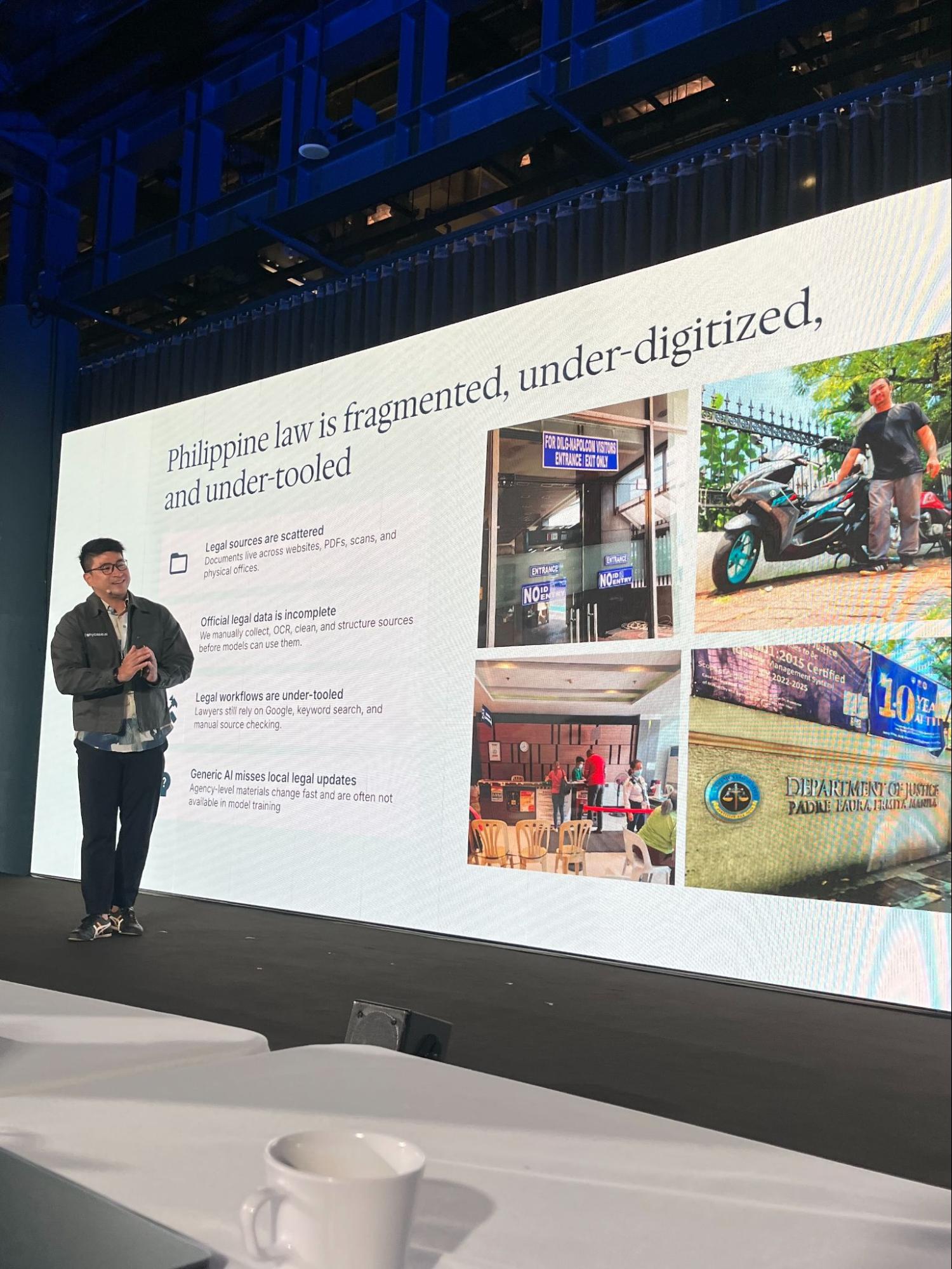
Beato, our co-founder and CEO, took the stage and told the on-the-ground story we uncovered while building Anycase.
It starts with a broken system
When we started Anycase, the obvious problem was that Philippine lawyers were still relying on Google and keyword search for legal research. That seemed like a solvable problem.
Then we dug deeper.
The real problem is the data. Philippine legal information is technically public, but it's spread across more than 150 national-level government agencies and departments, each maintaining their own website at varying degrees of reliability and completeness. After years of working in this space, our legal intelligence team found that 100% of these agency websites are missing complete historical legal information.
Every single one.
Rules and regulations that govern legal transactions and cases being filed today are lacking on the open web. You can't find a lot of them on Google. Which means general-purpose AI tools like ChatGPT and Microsoft Copilot can't find them either. An AI model is only as good as what it was trained on, and this data was never there to begin with.
This is the environment Philippine lawyers work in every day, and it’s why we built what we built.
Meet our data runner, Kuya Ry
In his talk, Beato introduced the audience to one of our team members we call our data runner. Kuya Ry.
His job is exactly what it sounds like. He rides his motorbike to one of the 150+ government agencies, lines up for two to three hours, and waits for them to hand over their data. Sometimes we get a digital file. More often, we get a physical stack of papers that we then have to scan, OCR, and clean up manually.
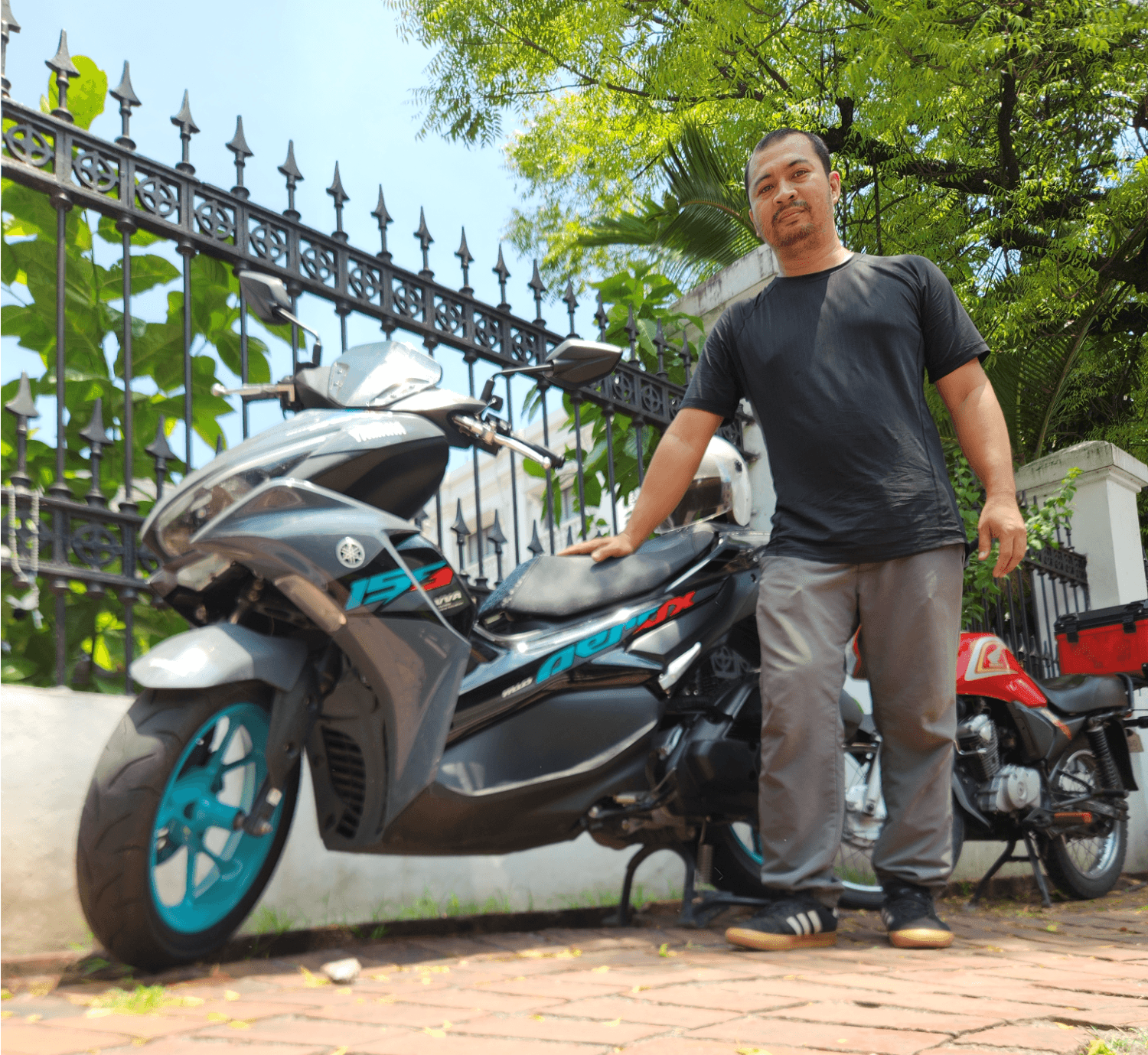
The whole process - from request to delivery - takes anywhere from two weeks to three months.
We know how this sounds. It's slow. It's expensive. It doesn't scale the way software is supposed to scale.
But here's the thing: no one else was doing it. And without this data, everything else we build is just a better search box on top of the same broken foundation.
So we do it.
What we actually built
We call it our Legal Intelligence Layer. The idea is simple even if the execution isn't: we do all the data work so Philippine lawyers don't have to.
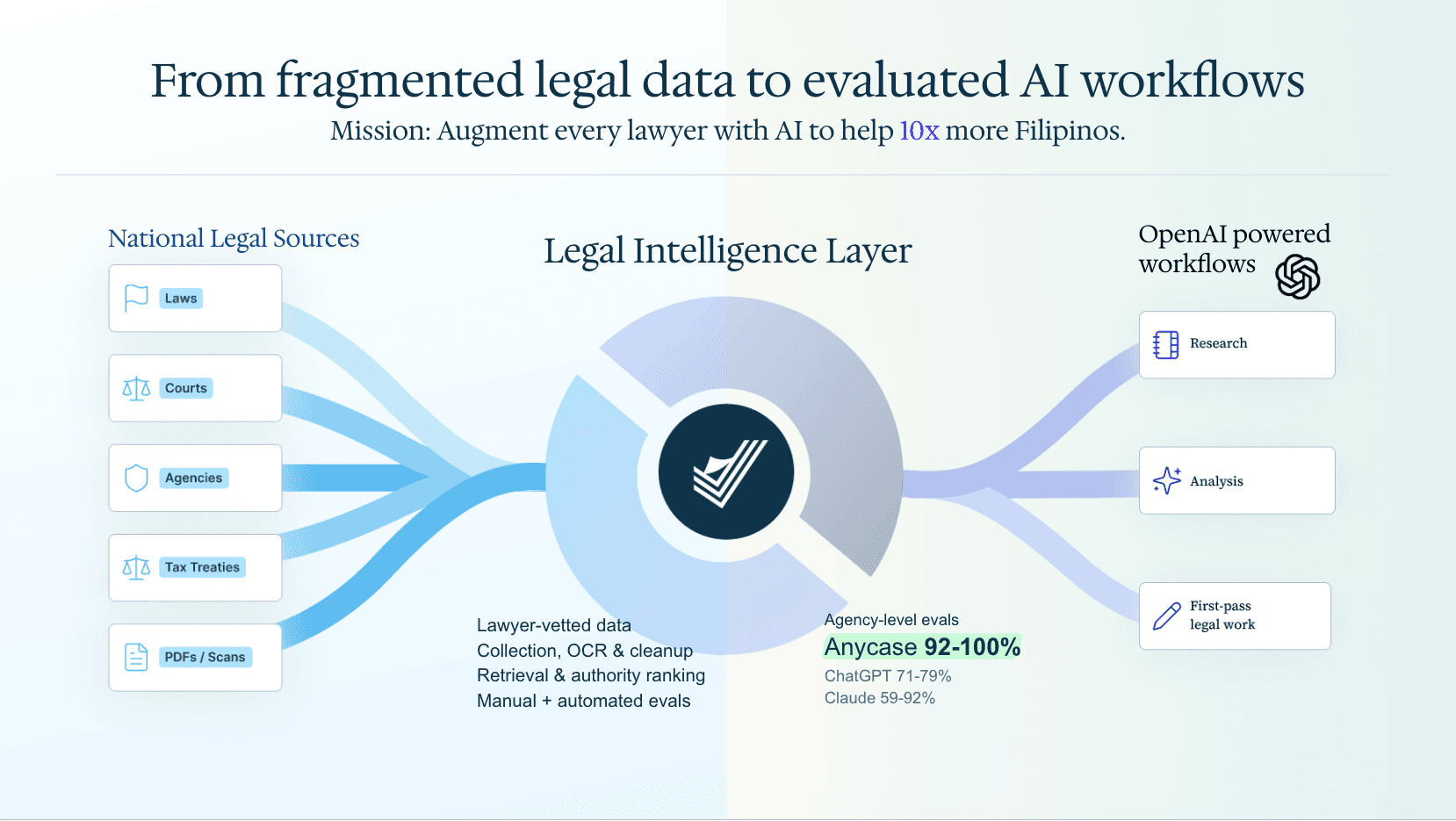
Our in-house team of lawyers and paralegals vets every document for completeness. If something's missing, our data runner goes back. We handle the collection, the scanning, the OCR, the cleanup. We tune our own retrieval and reranking models, optimized for recall, authority ranking, and coverage across the full body of relevant materials.
We also built our own evaluation benchmarks because none existed. We hand-rolled tests using the Philippine Bar Exam and created agency-level practice area evaluations for heavily-regulated practice areas like banking and finance, where the right answer depends on knowing current rules that aren't published anywhere online.
That's why we're able to hit up to 95% accuracy on Philippine Bar-style evaluations: because we have a specialized legal AI, built on top of a comprehensive legal library. We don’t just have a lot of data; we’re centralizing this fragmented network of Philippine legal authorities.
Our demo: A labor case
Beato walked through a labor case scenario: an employee dismissed after refusing to work unpaid overtime.
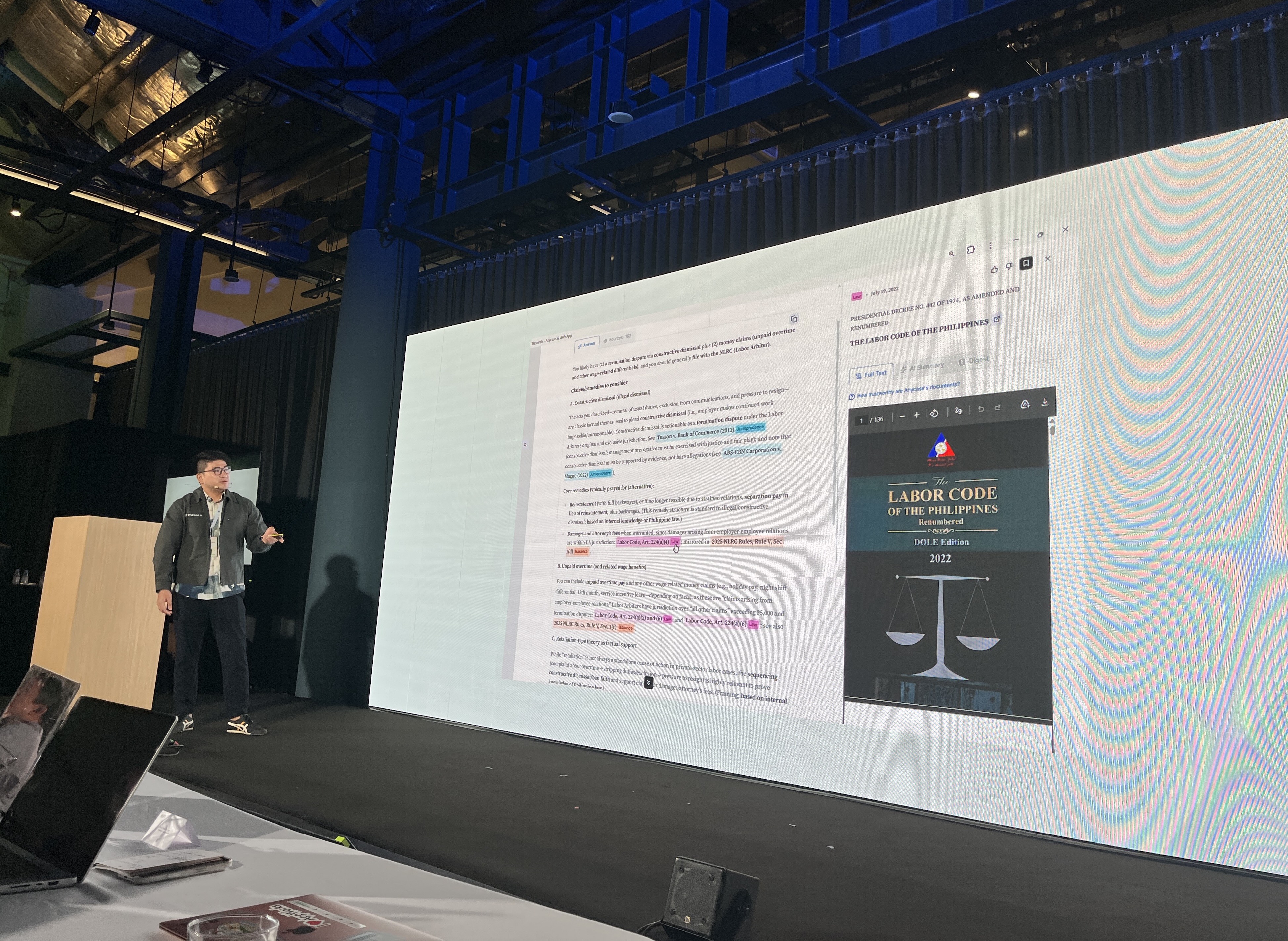
A lawyer types in the messy, unstructured client facts; no legal framing, no issue-spotting required. Anycase identifies the key legal questions (constructive dismissal, illegal dismissal), surfaces the relevant labor statutes, agency issuances, and Supreme Court jurisprudence, lays out available remedies, and walks through how to file a complaint with the National Labor Relations Commission with links to the actual source documents behind every claim.
When the labor arbiter rules against the client - finding that the employee voluntarily resigned - the lawyer can ask Anycase for help thinking through the appeal. Deadlines. Venue. Grounds. A checklist of procedural requirements to make sure the case doesn't get thrown out before it's heard.
"This is very important for lawyers who don't practice labor," Beato said on stage. "If I'm a criminal lawyer taking on a labor case, I don't actually know the procedure."
And when it's time to write? Anycase drafts the arguments, each grounded in real jurisprudence. The lawyer can highlight any paragraph, hit "Add citations," and the system finds cases that actually support that specific argument, cross-checked against what the court actually ruled.
We're not trying to replace the lawyer. We're trying to get rid of the blank page.
Where we are now
Our community consists of over 10,000 legal professionals and law students: solo practitioners, partners at law firms, government officers and everything in between.
We closed the oldest law firm in the Philippines as a customer. We've run institutional pilots with prestigious government offices. Our evals are strong and getting stronger.
And we got to share all of this at OpenAI Founder Day, on a regional stage, as the only Filipino startup in the room.
Why we're telling this story
The Philippines has 117 million people and roughly 80,000 lawyers. Most Filipinos who need legal help can't easily get it. That's not a technology problem: it's an infrastructure problem. The data was never collected. The tools were never built. The foundation was never laid.
We're trying to build it.
"I've always believed the Philippines should not just be a market that imports software built elsewhere," Beato has said. "We can build deep, local, domain-specific AI too."
Getting invited to OpenAI’s Founder Day, along with the well-wishes and feedback from attendees after Beato’s talk, was a good reminder that the world is paying attention. There's still a lot of work left. The data gaps are real. Coverage is never fully complete. The motorbike rides to government agencies aren't stopping anytime soon.
But we're building something that didn't exist before. And for the Philippine lawyers who've been working without it, and the everyday Filipinos who suffer the downstream effects to their access to justice, that's the point.
—
About Anycase.ai
Anycase.ai is an AI-powered legal research platform built for the Philippine legal system, trusted by over 10,000 legal professionals and law students. Learn more at anycase.ai.
Anycase.ai presented at OpenAI Founder Day in Singapore as one of five selected Southeast Asian startups. This does not constitute an endorsement or partnership with OpenAI.
Headquarters: Level 21, 8 Rockwell, Hidalgo Drive, Rockwell Center, Makati City
CEO & Co-founder: Beato Bongco
Community: 10,000+ lawyers, legal professionals and law students
Contact: Gio Tiongson, CGO & Co-founder (gio@anycase.ai) | anycase.ai