[Release notes] May 2026: AMLC, BSP documents, and two new core features coming soon
Anycase.ai

Data and accuracy
Anti-Money Laundering Council (AMLC) and Bangko Sentral ng Pilipinas (BSP), now on Anycase.ai
As of May 2026, Anycase’s library now includes an additional 1,256 documents, with key focus on DILG, BOC, BIR, DOJ, and SEC additions. Starting May 2026, issuances from the Anti-Money Laundering Council and the Bangko Sentral ng Pilipinas will be available to all users.
These additions reflect Anycase.ai's continued expansion beyond litigation and legal research into the broader regulatory and compliance ecosystem.
By incorporating AMLC and BSP issuances, Anycase now better supports compliance officers, in-house legal teams, financial institutions, regulated businesses, and professionals who rely on current administrative issuances to make operational and regulatory decisions. Key additions include:
AMLC
Guidelines on Digitization of Customer Records, which mandates covered persons to digitize and centralize know-your-customer (KYC) / customer records into a secure, readily accessible database, making it a practical reference for lawyers advising on AMLC readiness, defensible record-retention, and rapid lawful production of client/account documents during investigations or litigation
Guidelines on Transaction Reporting and Compliance Submissions, which standardizes covered transaction report and suspicious transaction report submissions (including counting of “working days” for deadlines), making it a practical reference for lawyers designing internal escalation and reporting workflows and managing exposure for late, incomplete, or inconsistent reporting under the Anti-Money Laundering Act of 2001, as amended in 2013 (2013 AMLA Amendments).
Guidelines on the Preservation, Management, and Disposal of Assets Subject of a Freeze Order, Asset Preservation Order, and Judgment of Forfeiture, which sets the framework for preserving, managing, and disposing of assets covered by a freeze order, asset preservation order, or judgment of forfeiture, including inventory/appraisal, receivership, sale of perishable assets, and accounting of allowable expenses to be deducted prior to turnover of the net value to the National Government (or, where applicable, a foreign jurisdiction)
BSP
User Guide for Sustainable Finance Taxonomy Guidelines, which guides banks on how to apply the Philippine Sustainable Finance Taxonomy Guidelines in assessing whether an economic activity meets the environmental objectives and the essential criteria of Do No Significant Harm (DNSH), Remedial Measures to Transition (RMT), and Minimum Social Safeguards (MSS).
2023 Amendments on Credit Card Interest Ceilings, which amends BSP regulations on credit card pricing by setting a cap on interest/finance charges at 36% per annum for all credit card transactions, imposing a separate maximum 1% monthly add-on rate for installment loans, and limiting cash advance processing fees to Php200 per transaction, with the BSP to review these caps semi-annually.
AFASA Rules of Procedure, prescribes the procedures and standards for the BSP’s inquiry into financial accounts and sharing of financial account information in relation to acts covered by the Anti-Financial Account Scamming Act (RA 12010), implementing BSP’s authority under AFASA and governing how BSP-supervised institutions may be required to provide and transmit relevant account information.
One-off ingestions for May 2026
For May 2026, we’ve added a set of targeted cases into our legal library:
With the rollout of our Superseded Law Handling system, our Legal Intelligence Team can move more quickly in identifying and uploading missing authorities that directly resolve real user queries.
Systems like these make our coverage more responsive, ensuring that the right authority surfaces because it has been deliberately tracked, updated, and prioritized.
Finance and banking evaluations, now available
We’ve also released our latest evaluation for the Finance and Banking domain, covering complex queries that require the citation of issuances from BSP, PDIC, CIC, IC, and AMLC.
The results point to a clear pattern: depth of legal coverage is what drives answer quality. When key issuances are missing, answers become incomplete or unreliable.
Coverage sets the foundation, but it’s not the only layer we have. Manual evaluation and ongoing input from our Legal Intelligence Team ensure that what gets retrieved is reviewed, corrected, and aligned with what is actually controlling.
New features and releases
Improved profile page and extend plan button
We’ve updated the profile page to make it easier to navigate and manage your account.
You can now extend your plan directly from the interface with a new Extend Plan button, so you don’t need to leave your workflow to make changes. We’ve also refined the layout and added a dropdown menu for quicker access to profile actions.
Vote thumbs up or thumbs down for AI answers
You can now rate responses using thumbs up or down button on the AI answers page.
We use this feedback to track patterns in how Anycase performs across different types of legal queries. During the Anycase 2.0 rollout, consistent downvotes on “digest” queries highlighted gaps in Edu mode, which directly informed the updates we shipped. These are manually reviewed by our Legal Intelligence Team, and helps us surface unsatisfactory AI answers.
Upcoming features: File upload and Docdraft
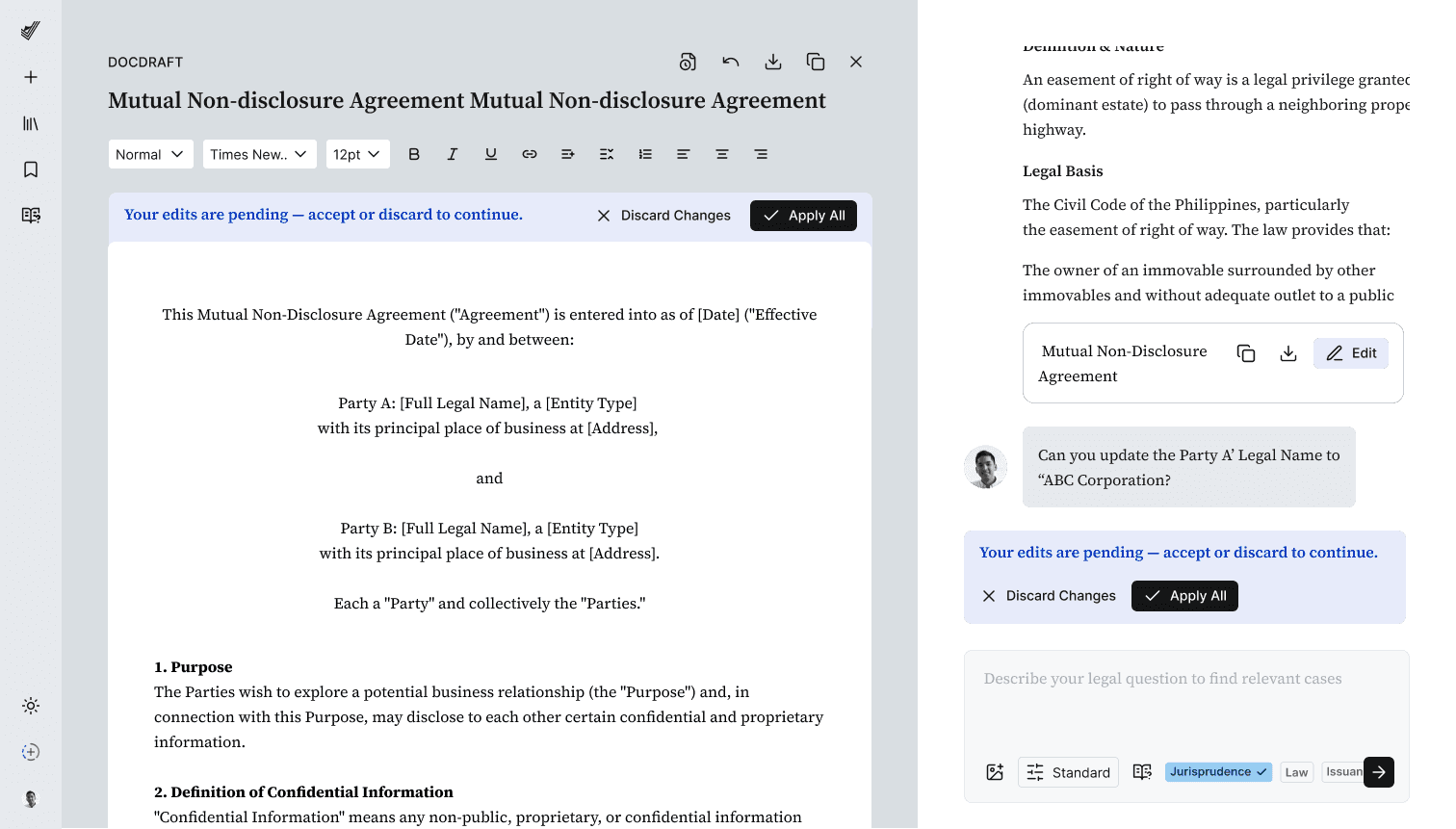
Since the beginning of this quarter, we’ve been building toward a more complete way of working inside Anycase. Soon, lawyers will be able to work through cases, legal opinions, memos, other documents end to end.
We're looking to introduce two new core features: File Upload and Docdraft.
These features are designed to support how legal work actually happens across firms, compliance teams, and in-house counsel, where research is only the starting point, and the real work lives in documents, outputs, and iteration.
When will the features be available?

We recently piloted the upcoming DocDraft feature with the Office of the Ombudsman, where it was used in real workflows and received strong feedback from users. That early use gave us a clearer view of how it holds up in practice, particularly for drafting and document-heavy tasks.
We’re now refining both features before making them more widely available.
We’re looking forward to getting these into your hands. We’ll share more as we get closer to release.
Here are some bug fixes and QOL improvements we did this May:
For May, the majority of our fixes have been focused on the Autosource Selection feature on the homepage, which have been causing some issues, particularly on mobile. We’ve since:
Fixed an issue where the Manage Library Sources button would overflow outside its container in follow-up question views
Improved how the button is positioned and contained within the follow-up question interface
Fixed display issues with the Manage Library Sources modal on mobile