[Release notes] April 2026: Tax treaties, SEC and BIR Citizen's Charter, and more
Anycase.ai
Data and accuracy
Tax treaties, now on Anycase.ai
As of April 2026, Philippine tax treaties are now available on Anycase, expanding coverage for cross-border tax planning, as governed by withholding tax (WHT) advisories, treaty-based remedies, and mutual agreement procedures (MAP).
PH-US Tax Treaty (1983), which allocates taxing rights and sets maximum WHT rates for common cross-border payments, and clarifies that Philippine-side relief (refund/credit) remains subject to Philippine procedural rules and statutes of limitations, making it a practical reference for deciding whether to pursue refund, TCC, or MAP-track options within deadlines.
PH-JP Tax Treaty (2009) (Protocol/Amendment), which updates the 1981 PH-Japan treaty rules by revising distributive provisions (notably reduced WHT on certain passive income streams) and refining key technical concepts (e.g., PE and transfer pricing adjustment language).
PH-CN Tax Treaty (2002), which allocates taxing rights and imposes maximum WHT rates on dividends, interest, and royalties, and functions as the controlling PH-China treaty framework for source-country WHT limitation and residence-country relief planning in China-related inbound/outbound cash flows.
One-off ingestions for April 2026
While our standard approach is to ingest entire agency libraries, we identified these Citizen’s Charters as high-impact additions, particularly for users navigating procedural questions and end-to-end workflows.
This reflects a broader focus on making Anycase’s answers more actionable, on top of being accurate.
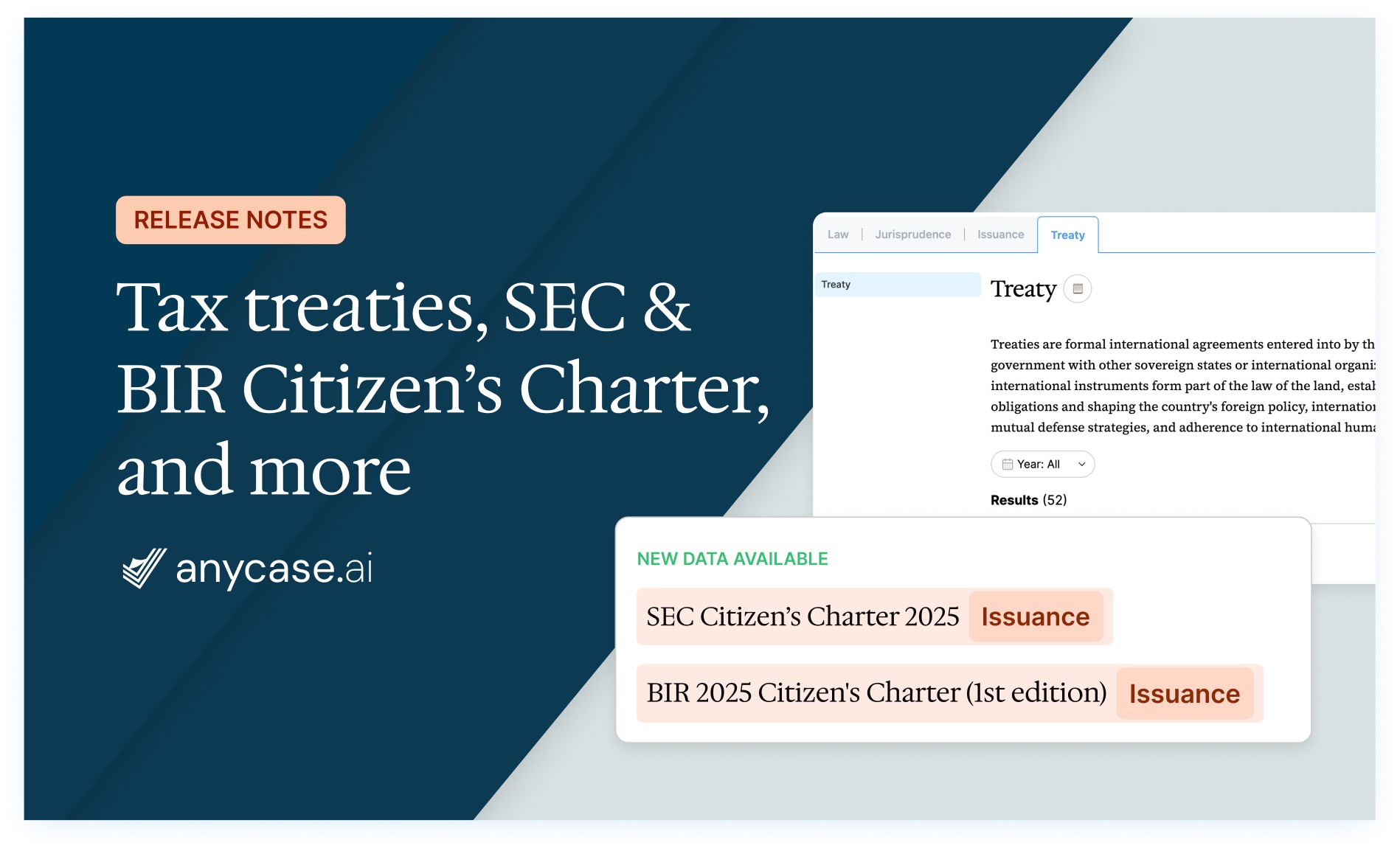
Recent additions include:
We’ll continue to expand coverage in the coming months. If there are specific materials that are critical to your practice, please submit a request through legal@anycase.ai. Your feedback directly guides which documents and features we prioritize for the coming months.
2025 Bar Evaluations: Anycase, OpenAI, Gemini, and Claude
As we expand our legal database, evaluations ensure two things remain true:
Accuracy is preserved even as new documents are introduced
The value of a specialized legal AI, paired with a curated legal library, remains clear against general-purpose models
Our goal is straightforward: make it easier for lawyers to rely on their chosen AI tool with confidence, knowing that performance is being measured, not assumed.
We’re closing our round of evaluations and publishing scores and comparisons for the top-of-mind models in an upcoming blog post.
Refining our evaluation criteria using Supreme Court rubrics
Our benchmarking framework, the RAG Triad (answer correctness, groundedness, and context relevance, scored on a -1 / 0 / +1 scale), remains the foundation of how we evaluate system performance.
We are refining this framework to adopt the 5-point grading scheme consistently used by the Philippines Supreme Court to more closely reflect the structure of the Bar Examinations in the country.
Agency-level evaluations, coming soon
As our legal library grows, our focus is on making sure you’re always surfacing the most relevant law.
With more documents comes more overlap across agencies, so we continuously evaluate and refine how the system identifies and prioritizes the right authority.
Our next phase of benchmarking focuses on:
Identifying and retrieving the correct source across overlapping agencies (e.g., Bureau of Customs vs DOF)
Maintaining accuracy and consistency
This work directly powers our newest feature: Autosource selection.
With Autosource selection, you no longer need to choose a library yourself. Anycase understands your query and selects the most relevant sources automatically, so you can trust that you’re not missing key documents, even as our coverage expands.
New features and releases
Autosource selection
Legal research has traditionally relied on the practitioner’s ability to identify the right sources. Anycase’s Autosource Selection removes that dependency.
Grounded in consistently strong retrieval performance across our evaluations, Autosource Selection enables Anycase to interpret the substance of a query and dynamically determine the most relevant sources.
It then retrieves, prioritizes, and anchors its responses in the controlling authorities, without requiring manual source selection.
Superseded law handling
Previously, older or replaced laws could still appear in results, especially where multiple versions or amendments existed. This made it harder to rely on whether the cited provision was the one currently in force.
Superseded law handling is a custom, internal tool that allows our Data Engineering and Legal Intelligence Teams to actively manage that.
This also strengthens how quickly we can respond to issues. Errors reported by users, such as incorrect metadata, tagging, or titles, can now be identified and resolved within 24 hours through this internal system.
In practice, this means:
You’re citing the current, controlling law by default
Outdated or replaced provisions are less likely to appear in answers
Still allows access to older versions when your query calls for them
More comprehensive lists for "list me X cases" queries
We've changed the way Anycaes lists cases, now providing a more exhaustive list when asked to find cases and perform similar searches.
Previously, Anycase will repeat already surfaced authorities when the user asks to see more. With recent improvements to its retrieval ability, Anycase will more reliably surface not only relevant, but distinctly unique cases, helping you build a more comprehensive list for litigation or general legal research.
Shorter law titles
Based on user feedback, we’ve introduced shorter, more recognizable law titles alongside formal citations.
This makes it easier to scan results, identify familiar laws, and distinguish between similar issuances quickly.
Digest prompts with citations
Digest outputs now include direct citations. Similar to Anycase’s standard AI answers, this makes it easier for students to verify key points against the original source material.
🛠️ Here are some bug fixes and QOL improvements we did this April
Search UI improvements
Minor changes to search UI to improve readabilityBookmark behavior update
Bookmarked pages now display Digest content instead of AI Summary for faster review of key case points